Dialogue forum highlights urgency of risk-based oversight for NPOs
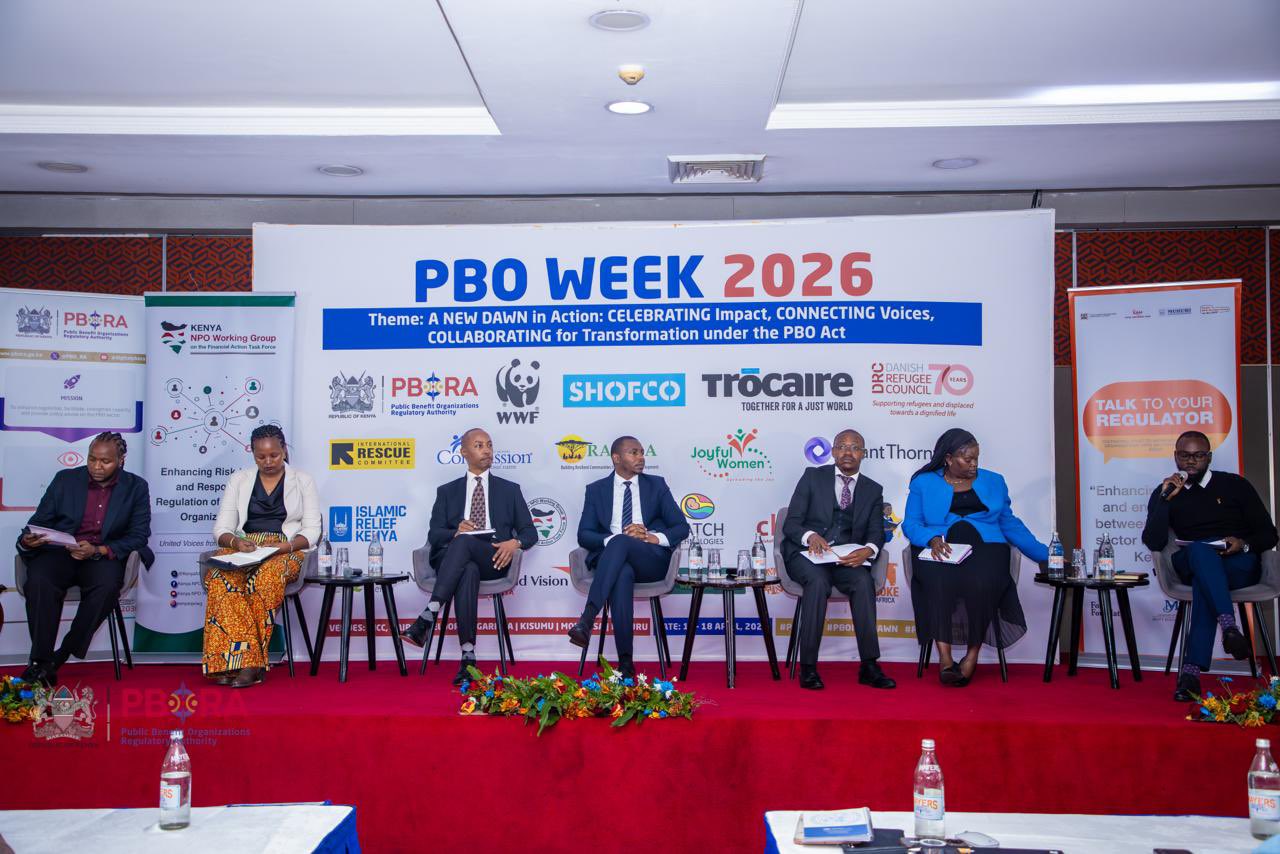
The ongoing PBO Week on Wednesday featured a high-level dialogue forum at the Kenyatta International Convention Centre (KICC), with discussions focused on navigating the Financial Action Task Force (FATF) risk-based monitoring framework for Non-Profit Organizations (NPOs).
Setting the stage for the conversation, Public Benefit Organizations Regulatory Authority (PBORA) Director General, Dr. Laxmana Kiptoo, warned that the PBO sector remains vulnerable to abuse by entities that are not genuine public benefit organizations, forums, federations, or unions.
He noted that the government, through agencies such as PBORA, is keen to protect the country from money laundering and terrorism financing.
“The PBORA is an implementing agency for the FATF actions in Kenya, and we are committed to safeguarding the country from money laundering and terrorism financing as required by the FATF Recommendation 8 and Section 43A of the PBO Act,” he said.
The FATF is an international, multi-governmental body established in 1989 as a global watchdog against money laundering and terrorism financing. It sets global standards that countries apply in combating illicit financial flows.
These standards comprise 40 recommendations addressing terrorism financing, money laundering, and proliferation financing. Recommendation 8 specifically focuses on NPOs, requiring countries to protect the sector from terrorist financing abuse.
This is to be achieved through targeted, risk-based measures rather than blanket regulations that could undermine the legitimate work of NPOs. The recommendation calls for regulatory and oversight actions that are proportionate and non-disruptive to legitimate charitable work, while preventing the misuse of NPOs as conduits for illicit financial flows.
In her keynote address, the United Nations Office on Drugs and Crime (UNODC) Regional Advisor, Ms. Atuweni Tupochile, acknowledged the critical role played by PBOs in Kenya’s national development but cautioned that terrorism financing within the sector remains a real risk.
“Across the country, PBOs are delivering humanitarian assistance, strengthening communities, and offering critical services in high-risk areas. These contributions directly support Kenya’s national development priorities and constitutional values,” she said adding, “at the same time, our national risk assessment has identified terrorism financing as a real and involving threat and this is precisely why the FATF Recommendation 8 must be understood not as a constraint on civil society but as a risk management tool to promote credibility and sustainability.”
She advised PBORA to adopt the risk-based monitoring framework, which avoids blanket measures in preventing terrorism financing and money laundering.
“For Kenya, particularly the Regulator, this means regulation that is risk-informed, drawing directly from the National Risk Assessment and Management that is non-punitive in design, respects constitutional rights, civic space, and humanitarian principles.”
Ms. Tupochile further called for multi-agency collaboration in implementing Recommendation 8 to ensure that the legitimate work of NPOs continues unhindered.
“Successful implementation of Recommendation 8 in Kenya requires a whole-of-sector approach with the government and regulators applying targeted NRA [National Risk Assessment] aligned oversight, exercising proportionate consecutive regulations, strengthening internal governance, and development partners supporting compliance without undermining impact,” she said.
Mr. Abdille Hassan, Country Director at Islamic Relief and Coordinator of the NPO Working Group on FATF, said PBORA has been a dependable partner in efforts to safeguard the sector from abuse. He added that the Working Group collaborates with stakeholders to ensure that the NPO space is not infiltrated by illegitimate entities.
“When we initiated the process, it was hard to work with the government, and I am glad that the Regulator has been very instrumental in this initiative. It is something that we aspired to have. We work to ensure that we are free from terrorism financing through educating our members,” he said.
The discussions come at a time when Kenya is working to exit the FATF grey list. A country is “grey-listed” when it has significant weaknesses and gaps in its Anti-Money Laundering and Counter-Terrorist Financing (AML/CFT) framework.
This status carries serious implications for international relations due to its negative reputational impact. Countries on the grey list often face heightened monitoring and may encounter challenges in accessing critical international financial systems.
Once a country addresses identified deficiencies in its legal and regulatory frameworks, it can be removed from the grey list. PBORA’s Manager in charge of Research, Ms. Bernadette Nzomo, said in her presentation that Kenya was grey-listed due to the need to deregister non-compliant NPOs, amend laws to avoid overburdening the sector, categorize NPOs based on risk vulnerability, and establish a risk-based monitoring framework.
“We needed to change the law to ensure that we do not burden the Non-Profit Organizations, and we were working together with the FIU, that is the Financial Reporting Center, to ensure that the law has been amended not to burden the Non-Profit Organizations,” she said.
The PBO Act, 2013, was amended in 2025 to introduce Section 43A, which empowers PBORA to oversee and monitor public benefit organizations at risk of terrorism financing.
Ms. Nzomo further noted that the Authority conducted a sectoral risk assessment in 2024 to identify inherent risks within the sector, revealing seven key vulnerability factors.
In November 2025, PBORA held a stakeholder workshop on the risk-based monitoring framework for NPOs at risk of terrorism financing in Nairobi. Participants from various non-profit organizations were taken through the framework.
Key components of the framework include risk assessment, mitigation measures, outreach and information sharing, as well as effective monitoring and supervision, guided by the principles of proportionality, effectiveness, and international cooperation.
With sustained commitment and coordinated efforts, Kenya is expected to make significant progress towards exiting the FATF grey list.