PS Dr Omollo: War on terror financing on, civic space intact
NAIROBI, November 17, 2026 -The Government has reaffirmed that fighting terrorist financing and protecting civic space are complementary goals, not competing ones.
The Principal Secretary for Internal Security and National Administration, Dr Raymond Omollo, said Kenya was fighting terrorist financing while protecting the civic space for organizations to carry out legitimate charitable activities.
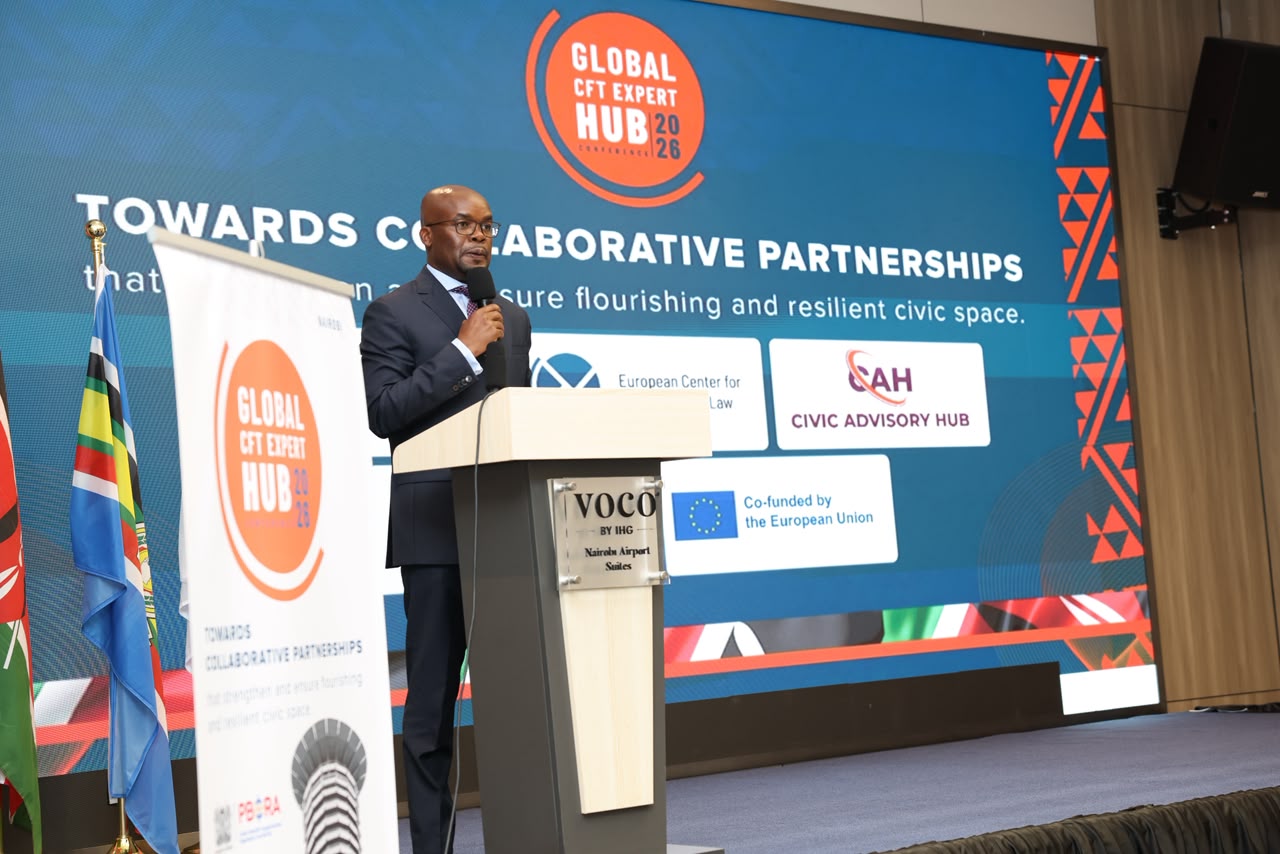
Dr Omollo made the remarks while officially opening the Global Countering the Financing of Terrorism (CFT) Expert Hub Conference 2026 at the Argyle Grand Hotel, Nairobi, on November 17.
“Kenya recognizes that these two objectives are complementary,” Dr Omollo told delegates,” he said.
The PS added: “An effective framework must be firm against abuse, proportionate in its application and responsive to the risks presented.”
Dr Omollo said Kenya had, as of October 2026, substantially addressed 19 of the 21 action items under its national Action Plan with the Financial Action Task Force (FATF) International Cooperation Review Group, and that Non-Profit Organisations (NPOs) had been removed from mandatory reporting entity lists to allow a more targeted, risk-based approach.
“Our approach is increasingly guided by evidence and risk assessment rather than blanket regulation,” he said, citing a recent assessment of 260 Faith-Based Organizations in nine counties, 90 per cent of which were rated Low or Medium-Low Risk.
The 5% rated High or Medium-High Risk faced enhanced on-site reviews, while the rest were subjected to routine annual desktop reviews.
“Risk management should not become risk avoidance,” Dr Omollo said, urging banks not to exclude legitimate non-profits from banking services simply because they operated within a particular sector.
He challenged participants to look beyond technical compliance and find practical solutions.
“Let Nairobi be remembered not simply as the place where we held an important conversation, but as the place where we agreed on what we will do differently,” he said.
The three-day conference is co-hosted by the Public Benefit Organizations Regulatory Authority (PBORA), the European Center for Not-for-Profit Law (ECNL), the Civic Advisory Hub the Kenya NPO Working Group on FATF.
It has drawn over 150 delegates from across the globe, including representatives of non-profit and civil society leaders, development partners, multilateral bodies, government, the banking sector and academia. They are expected to produce three action papers, including one on financial inclusion for non-profits.
PBORA Director/CEO, Dr Laxmana Kiptoo, thanked the Government’s continued leadership and commitment in the fight against money laundering and terrorist financing.
He said the conference theme, “Towards Collaborative Partnerships that Strengthen and Ensure a Flourishing and Resilient Civic Space,” demanded measures that were effective and proportionate.
“The fight against terrorist financing must strengthen, not undermine, the legitimate work of organisations that serve humanity,” Dr Kiptoo said, noting that PBOs complement Government development efforts.
He cited healthcare, education, humanitarian assistance, environmental conservation and community empowerment.
The Authority was committed to promoting compliance while facilitating legitimate public benefit activities.
Mr Kodjo Attisso, the Coordinator, Illicit Finance Fusion Center, United Nations Office on Drugs and Crime (UNODC), reiterated the growing international consensus that meaningful engagement among governments, financial institutions, supervisory authorities, and civil society organizations is essential to achieving effective outcomes.
He said UNODC supported member countries to deepen financial inclusion and integrity, including in the Non-Profit Organizations (NPO) sector.
He said the UN agency supported countries in conducting risk assessments to implement risk-based and proportionate measures without disrupting humanitarian and other legitimate NPO activities.
Mr Attisso said UNODC was also focused on strengthening partnerships and knowledge sharing, as well as regional collaborations in combating Money Laundering and countering the Financing of terrorism.
The civil society voice from ECNL, Civic Advisory Hub and the Kenya NPO Working Group was clear.
“Security and civic freedoms are mutually reinforcing. When governments, regulators, banks and civil society design AML/CFT measures together, those measures are more proportionate, more risk-based and more effective. Nairobi builds on this partnership, started by the Global Expert Hub in 2018,” said Vanja Skoric from ECNL, adding that “Cross-sector collaboration is difficult but, once achieved, very impactful.”
She said the Global Expert Hub was established in 2018 and now links civil society leaders and experts from more than 45 countries. It has met in The Hague, Vienna, Paris, Haarlem and Johannesburg.
The organizers’ position is that financial crime responses work best when grounded in human rights, transparency and meaningful civil society participation.
Yona Wanjala of the Civic Advisory Hub added that the civil society was not opposed to effective measures to combat money laundering and terrorist financing.
“We recognise the importance of financial integrity, transparency and accountability. Non-profit organisations must operate responsibly, maintain sound governance systems and protect their resources against abuse. However, security and civic freedoms should not be treated as competing objectives. They are mutually reinforcing foundations of stable, accountable and resilient societies,” he said.
The PBO Disputes Tribunal chairperson, Ms Anne Nderu was present.